Logistics
Shipments, carriers and exceptions visible before they become delays: dispatch sees the risk, not the customer call.

THE PROBLEM
Supply chains run blind across fragmented carrier portals, silent delays, and reactive phone chasing. Dispatchers juggle dozens of carrier tabs while delivery exceptions surface only when customers call—wasting hours chasing proof-of-delivery and manually calculating delay workarounds.
Carrier updates arrive in different formats and portals
Exceptions found late, usually by the customer
Dispatch decisions made from memory and spreadsheets
Proof of delivery chased by hand
MARKET SIGNAL
Where the Market Is Moving
Adoption and efficiency figures from published UK, US and European industry research, linked below.
17%
Fully automated transport operations
Only 17% of shippers and logistics providers in Descartes’ global TMS benchmark report fully automated processes, and over a third still lean on manual work.
21%
Productivity lift from smarter workflows
T&L organisations that meaningfully optimised workflows over two years reported about 21% higher employee productivity on average.
Source: Zebra / Oxford Economics, 2025
51% / 5%
Leaders vs laggards on full automation
51% of industry-leading financial performers are fully automated, against 5% of below-average firms. Automation tracks performance.
SECTOR PRACTICE
What Leading Operators Do
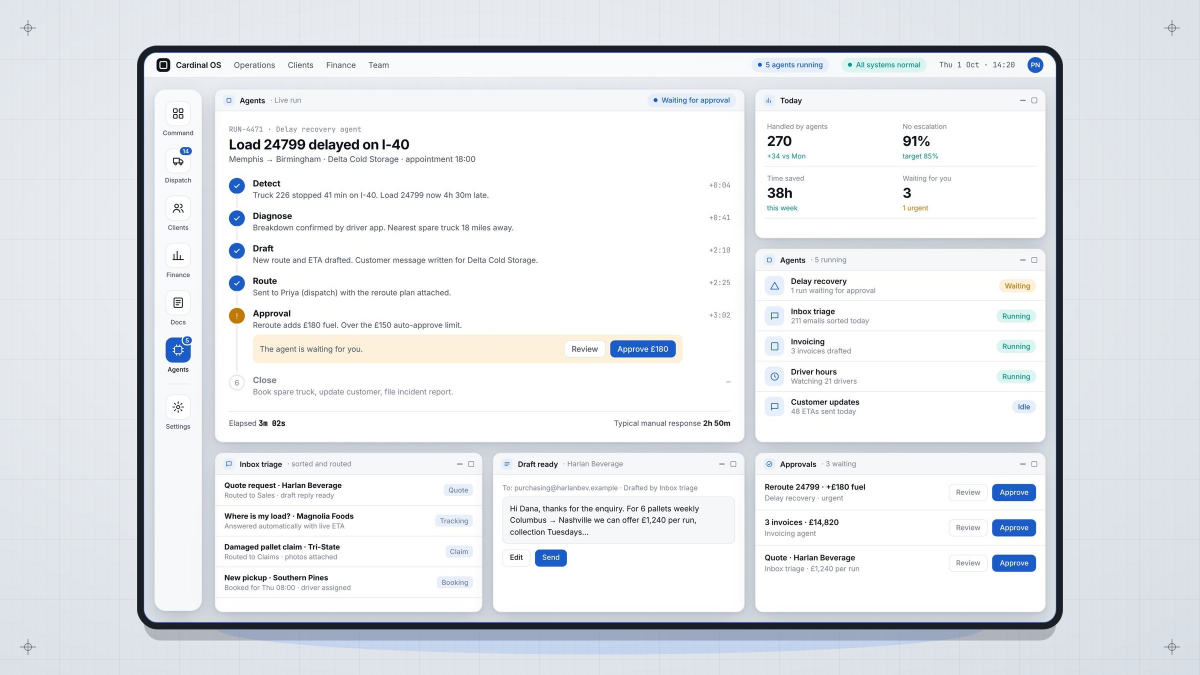
- VG-02 Company OS
Live Dispatch Boards
Loads, vehicles and ETAs on one board with late and at-risk shipments surfaced at the top, so dispatch acts on risk, not memory.
Explore Track - VG-04 Agent Operations
Exception Detection
Carrier feeds watched for delays and failed deliveries; customer updates and next actions drafted the moment the exception appears.
Explore Track - VG-05 Data Infrastructure
Normalised Shipment Data
Every shipment across carriers becomes one record ready for reporting and billing reconciliation, not a pile of portal exports.
Explore Track - VG-02 Company OS
Customer Self-Tracking
Customers check status, documents and proof of delivery themselves, clearing the phone line for real exceptions.
Explore Track
We engineer the systems that make these moves real, scoped through a Recon engagement first.
THE SHIFT
From Customer Call to Caught Early
A load is running late. Here is how dispatch finds out today, and how it plays out when an agent watches every shipment.
Found by the customer
hours after the delay started
Truck stalls; the carrier portal updates quietly
Nobody is watching that tab
Customer rings to ask where the load is
First sign of trouble
Dispatcher checks portals and calls the driver
Chased by phone
New ETA and extra cost agreed by email
Decided from memory
Caught in minutes
before the customer notices
Agent spots the delay in the carrier feed
Every shipment watched
Options and costs laid out, reply drafted
Rebook, reroute or hold
Dispatcher approves the extra cost
Approved in a click
Customer gets the new ETA first
Logged against the load