
[ 01 ] - REALESTATE
Overview
Diagnostic audit of a high-volume property group to transition from fragmented "Shadow AI" to a centralized, secure infrastructure layer. This project formalizes unregulated workflows and consolidates data silos into a singular, board-approved roadmap for long-term market survival.
Category
OPERATIONAL AUDIT
Privacy Disclaimer
To ensure security and confidentiality, case studies utilize anonymized data unless authorized.

Challenge
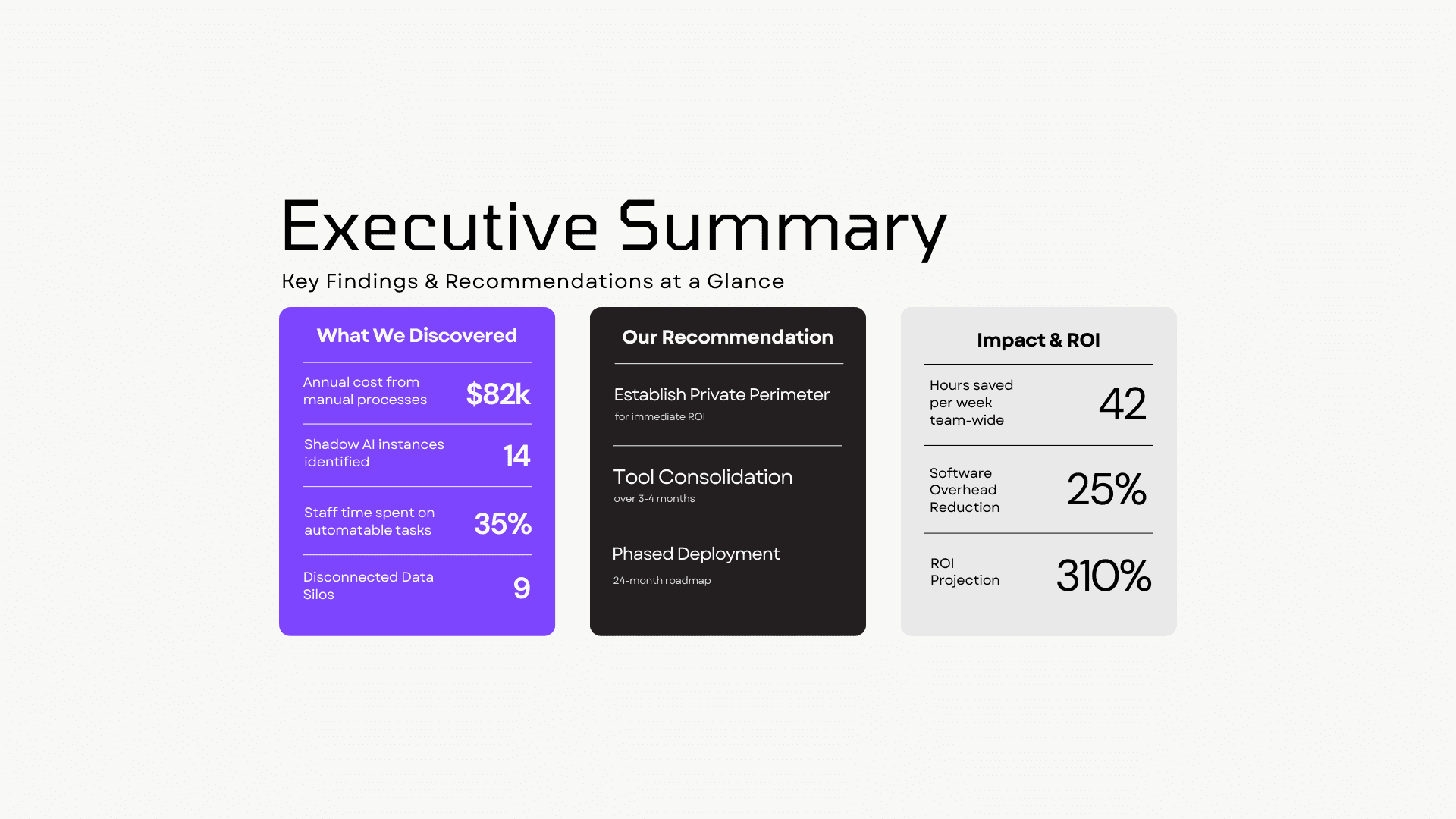
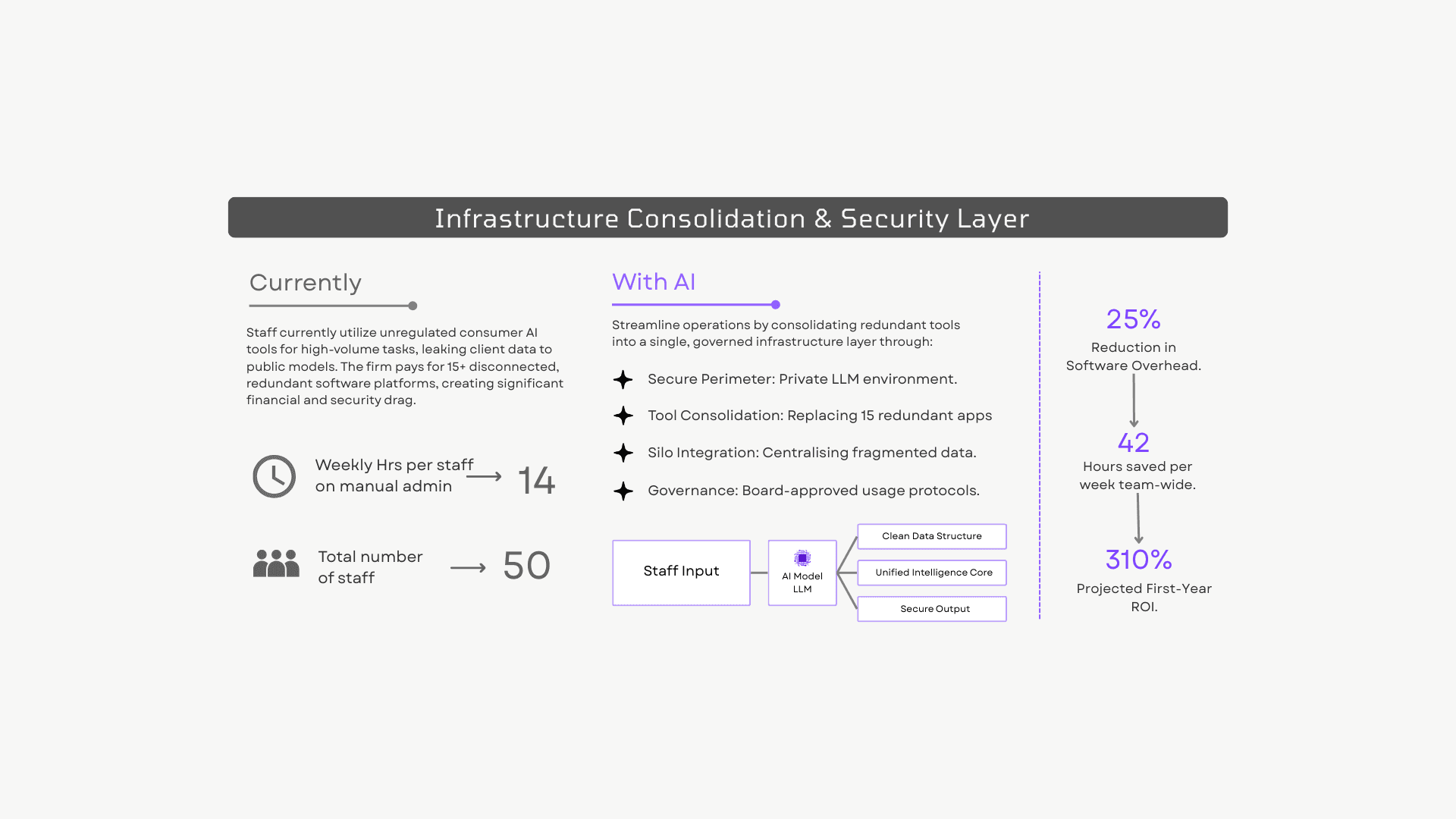
The client, a prominent local property management firm, was operating in a state of technical fragmentation. While leadership maintained a defensive posture regarding AI—citing security and data privacy concerns—the reality on the ground was far different. Staff were secretly utilizing consumer-grade AI models (Shadow AI) to manage overwhelming workloads, inadvertently exposing sensitive client data to public LLMs. Key Friction Points Identified: - Unregulated Data Leakage: Staff were inputting private lease agreements and personal client details into public tools to generate summaries and communications. - Software Bloat: The firm was paying for over 15 disconnected SaaS platforms, resulting in $2,400/month in redundant licensing fees for tools that lacked integration. - The Survival Gap: Competitors were beginning to utilize automation to reduce management fees; without a formal infrastructure, the firm’s overhead made them increasingly uncompetitive.
Impact
Veronix deployed a four-stage Infrastructure Diagnostic to map the company’s current state and engineer a path to autonomy. 1. Staff Infiltration & Workflow Mapping: We conducted blind interviews with department heads and junior staff to uncover "informal automation". This allowed us to identify exactly where AI was already providing value and where it was creating risk. 2. Silo Identification & Tool Consolidation: We audited every active subscription, identifying five redundant tools that could be eliminated. We mapped the data silos—where lead information was "trapped"—to design a unified data core. 3. Governance & Security Engineering: Veronix designed a "Protected Perimeter" for AI usage—a secure, private environment where staff could use the power of LLMs without data ever leaving the firm’s control. 4. The Final 24-Month Roadmap: We delivered a technical blueprint that categorized every required upgrade by priority, giving leadership a board-approved schedule for infrastructure deployment. ---------- Engineered Market Advantage: The audit shifted the company's culture from defensive fear to offensive velocity. The firm is no longer "reacting" to AI; they are building on top of it. - Financial Reclamation: The identified tool redundancies immediately saved the firm 25% in monthly software overhead, effectively self-funding the first year of their AI roadmap. - Risk Elimination: By formalizing AI usage into a secure, managed layer, the firm eliminated the legal and security risks associated with Shadow AI. - Operational Continuity: The firm secured its position in the market by transitioning from a manual-heavy model to an AI-ready infrastructure, ensuring it can scale without adding headcount. - Board-Level Certainty: Leadership now operates with a clinical roadmap, replacing the "fear of the unknown" with a structured engineering plan. NOTE: AI is a tool, just like an engine. If used incorrectly, things can break.
" transform="translate(26 13)" width="761px"/><path d="M 17.948 56.548 C 10.528 53.014 10.302 42.536 17.562 38.685 L 90.04 0.244 C 90.328 0.091 90.673 0.088 90.964 0.237 L 379 147.5 L 707.51 0.219 C 707.816 0.082 708.17 0.108 708.454 0.286 L 768.198 38.02 C 774.951 42.285 774.225 52.357 766.929 55.608 L 383.21 226.624 C 380.538 227.814 377.48 227.776 374.839 226.518 Z" fill="transparent" height="228.5px" id="LLwxKZ78X" stroke-dasharray="0" stroke-linecap="butt" stroke-linejoin="miter" stroke-miterlimit="4" stroke-width="3" stroke="rgba(171, 171, 171, 0.2)" transform="translate(26 330.5)" width="784px"/><path d="M 17.948 56.548 C 10.528 53.014 10.302 42.536 17.562 38.685 L 90.04 0.244 C 90.328 0.091 90.673 0.088 90.964 0.237 L 379 147.5 L 707.51 0.219 C 707.816 0.082 708.17 0.108 708.454 0.286 L 768.198 38.02 C 774.951 42.285 774.225 52.357 766.929 55.608 L 383.21 226.624 C 380.538 227.814 377.48 227.776 374.839 226.518 Z" fill="transparent" height="228.5px" id="Vtze6meDP" stroke-dasharray="0" stroke-linecap="butt" stroke-linejoin="miter" stroke-miterlimit="4" stroke-width="3" stroke="rgba(171, 171, 171, 0.2)" transform="translate(26 483.5)" width="784px"/></svg>)